Two Gnus: The Gnu Project and the Gnu GPL

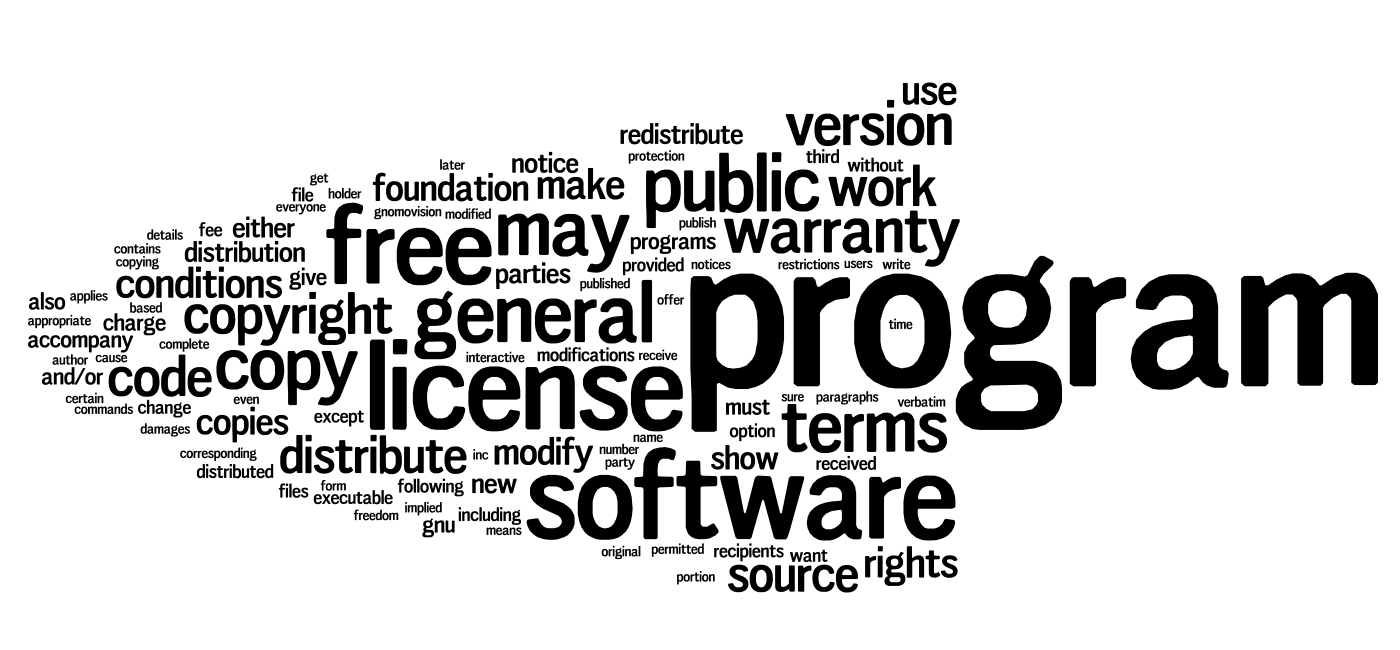
For the next Decoding Digital Humanities meeting, I’d like to propose reading two fundamental documents of the free software movement, Richard Stallman’s Gnu Project and the Gnu GPL (General Public License). These texts build on the last meeting’s reading of Eric Raymond’s The Cathedral and the Bazaar, but are less about the process of coding, and more on the programmer in the world. The first is a brief history of sharing code and a plan for a completely free operating system, the second the most popular free software license, designed to protect both sharing and code.

They’re relevant to the Digital Humanities, and what we’ve been discussing, in numerous ways:

  • They show the human culture around the code, both implicitly (styles of writing, ways of thinking about a problem) and explicitly (Stallman’s description of sharing at MIT). The humanity around the digital, one can say.
  • We face very similar problems with sharing other things, like data and findings. That sharing is fundamental to learning; too much material is being locked up under dubious copyright claims and illiterate t&cs, never mind paywalls.
  • Talking of paywalls, both texts have a subtle attitude to commerce, seemingly unconcerned with money but overtly opposed to monopolisation.

And of course, we use the fruits of these works.

More than that, I think these texts can be read in very different ways: beyond being a license, the GPL can be seen as a ‘hack’, repurposing copyright into copyleft; a history of debate and struggle is found across its three revisions (and its offspring for web-deployed software, the Affero GPL); the Gnu Project is history, philosophy, polemic and an embodiment of sheer will. Reading differently is what the (digital) humanities does.

Further discussion is for the pub; this is just to suggest some suitable – and interesting! – reading around which to talk.

Posted in digital humanities | Tagged , | 2 Comments

Murdoch redux

Following on from my previous post, some news:

The British Library has backed down from digitising and putting online out of copyright editions of the Times. This raises serious questions about its whole mission: are they resigned to the irreplaceable newspapers in Colindale crumbling over time, along with their deteriorating microfilm copies, without any digital preservation at all? It also sets a dangerous precedent in ceding public domain material to a private owner. Whilst this has no force in law, it has an intimidatory aspect. Still worse is that some of this material was not even created by The Times. Plus ça change….

And as a footnote, given The Times’ building of a paywall, Glyn Moody wonders whether commercial strategies should trump the public record: “Should retractions be behind a paywall?

Posted in commons | Tagged , , | Leave a comment

The Enclosure of the Historical Commons (2): Murdoch Junior

Last week James Murdoch spoke at the launch of UCL’s new Centre for Digital Humanities. Quite why they invited him I don’t know, for he appears to have no idea of what the Digital Humanities are. That said, his speech got plenty of media coverage, so it may have been a clever piece of publicity-mongering.

Notwithstanding his protestations to be speaking “as dispassionately and factually as I can”, it was a partisan and aggressive statement for the so-called “creative industries.” The usual suspects were lined up: the BBC, file sharers, the public sector, search engines, digital utopians et al. The notorious Tera report was cited, apocalyptic visions of redundancies painted (how ironic coming from Wapping), government enforcement of “basic property rights” demanded, Sky iPhone apps and Fox films promoted.

(It was also semi-literate: “almost exactly”; “the era of Pope, and Johnson, and writers after them.” As for the trite Tolkein quotation, was he trying to show he was down with the geeks?)

But it was the attack on the British Library’s newspaper digitisation program that garnered most of the headlines; see, for example, The Indy and The Guardian. The library’s project aims to turn some 40 million pages of their newspaper holdings into searchable, preservable, accessible, distributable text; a great resource for historians. The majority of this material is clearly out of copyright and in the public domain. Where it is not, there will be agreement with, and remuneration for, the copyright holders. The press release states:

…. the partnership will also seek to digitise a range of in-copyright material, with the agreement of the relevant rightsholders. This copyright material will, with the express permission of the publishers, be made available via the online resource – providing fuller coverage for users and a much-needed revenue stream for the rightsholders.

So what’s Murdoch getting so angry about? Immediately, competition with archive.timesonline.co.uk. It’s curious he didn’t take the opportunity to plug that product along with all the others. But there’s something else: free content.

Just yesterday, the Library announced the digitisation of their newspaper archive – originally given to them by publishers as a matter of legal obligation. This is not simply being done for posterity, nor to make free access for library users easier, but also for commercial gain via a paid‐for website. The move is strongly opposed by major publishers. If it goes ahead, free content would not only be a justification for more funding, but actually become a source of funds for a public body.

As the old saw goes, there’s free as in freedom, and free as in beer. One means the freedom to use a resource in any fashion, the other simply not to pay for something. The British Library project is not free in either sense, as I’ve previously shown. Likewise the Times archive.

Clearly, the “free content” referred to is material on which copyright has expired and which is now in the public domain. It can be used in any way anyone desires. The problem is obtaining it. That means only certain institutions, the British Library and News International alike, can take advantage of this common wealth, and enclose it with an array of technological (DRM), financial (paywalls) or contractual (the terms of use and copyright claims over remastering into digital formats) fences.

For Murdoch, this isn’t enough. He believes the Times archive is his inviolable property. Although in practice only the British Library can compete with him, the root problem is that this material is in the public domain. Consequently, not only does he berate public sector competition for “profiting from work they do not create”, but demands that only the creative industries should be allowed to “develop and protect the value of what they create”,  even where copyright has lapsed. This privatisation envisages the digital humanities as an adjunct to commercial exploitation, in line with current ideologies of the “impact agenda” and business-driven education; and it dramatically diminishes our historical commons.

Standard caveats: I am not a lawyer. Nor do I play one on TV. Nor am I a mind-reader with privileged access to the inner workings of the mindset of the wealthy.

See also  Richard Lewis and The Guardian.

You can read the transcript here and here. Curiously, neither page has an explicit copyright statement, so presumably both sites are claiming the rights to the lecture!

Posted in commons | Tagged , , , , , | 1 Comment

Money the measure of all things

Despite currently studying at Kings College London, I haven’t been involved in the campaigns against the cuts in higher education in the U.K. Partly this is due to a lack of time, but also because I’ve been burnt out by politicking.

But news today that Middlesex “University” (should read: Corporate Services Provider) is to shut down the philosophy department has caused the bile to rise.

The Dean, one Edward Esche, has stated that the decision is “purely financial” and that the department has no “measurable” contribution to the university.

Yet it is an internationally renowned department, the highest research-rated subject in that University, a grade 5 rating in the 2001 RAE assessment, a 2.8 in the 2008 assessment, with “65% of its research activity judged ‘world-leading’ or ‘internationally excellent’.”

Despite the malevolence of the RAE, it does produce some sort of measurement, one designed for managers and bureaucrats such as this Dean who has arbitrarily disregarded it. Whether he has done so because he truly believes ‘money is the measure of all things’, or he is hiding his real reasons (too critical? not ‘useful’ enough?), the result is the same. An agenda driven entirely by commercial concerns, one that has finally disposed of any educational and academic criteria.

Opposition is gathering: see the Save Middlesex philosophy website and facebook page for more details.

Posted in edubiz | Tagged | Leave a comment

Alchemy and Economy

Due to overwhelming popular demand *cough* I mean, as I had a couple of requests for it at Christopher Moses’ talk on Money Matters at the IHR a few weeks back, I’m posting the PDF of an essay I wrote 10 years ago on alchemy and economics. I’ve done a little tidying up, but it’s substantially unchanged.

I’ve been interested in monetary crime since reading George Caffentzis’ remarkable Clipped Coins, Abused Words and Civil Government (Open Library record). This led me to write a dissertation on coin clipping and the ‘Great Recoinage’ of the 1690s for my B.A. at the University of North London, and also gave me a taste of the delights held by the archives. The present essay, for an M.A. course, was a spin-off from that, as I had a sense of an alchemical subtext lurking in the background; the clippers were accused of being alchemists, their nemesis Isaac Newton was one, and there are fleeting mentions of it in the voluminous contemporary pamphlet literature.

A couple of disclaimers: as Moses mentioned at the seminar, the technologies developed at Potosi for extracting gold is an important element in this story, and one absent from this essay. There’s nothing about the coin clippers themselves, yet they’re the most interesting part of the whole story. I don’t like the way it is written; rather thick with academese.

But for all that, the economic aspects of alchemy have been ignored, and it does have the merit of giving voice to George Starkey’s marvellous espousal of inflation!

This article is released under a Creative Commons Attribution-Noncommercial-No Derivative Works 2.0 UK: England and Wales License.

Levin, Alchemy and Economy PDF

Posted in My Projects | Tagged , , , | Leave a comment

London Lives, Plebian Lives

A few weeks ago I went to a presentation of the London Lives project, held by the Long 18th Century seminar at the IHR. This ambitious undertaking aims to integrate the records of some of London’s major organizations – among them, the Old Bailey, Bridewell, St Thomas’ hospital – into a website that allows researchers to follow the lives of the ‘lower orders’ in their interactions with the legal, charitable and medical institutions of early modern London.

This is a phenomenal amount of data: over 3 million names, 1,300 to 1,600 separate manuscripts, around a quarter of a million pages, some 40 million words in all. Which means it needs a decent interface and facilities, or else one will just be swamped by raw, muddy data. Judging by the demonstration given by Sharon Howard, it looks like it has been designed with researchers in mind, with the ability to cross reference records and link entries together in sets.

Two examples of using the site were given. Tim Hitchcock deftly restored the reputation of the much-maligned nurse Hannah Poole, falsely accused of being uncaring and negligent; Bob Shoemaker showed a perhaps surprising distance between the criminal world and the poor, members of one rarely showing up in the records of the other.

Digital projects have to have a research question, and the one behind London Lives is: how did the poor and the plebian relate to the welfare authorities in early modern London? There were a number of questions raised as to which term to use – the project was originally entitled ‘Plebian Lives and the Making of Modern London’, which was dropped because of the difficulties of defining class in this era (not to mention the presence in the records of numerous higher class individuals, such as administrators). Hence the new title ‘London Lives’, both more specific in location and more general in scope.

There is one aspect to this question that concerns me: it frames the poor in terms of their institutional existence. Of course, there are few records of the poor that come ‘from below’, from their own mouths, especially when illiteracy is the norm. And of course, these institutional sources offer much rich material for understanding the lives of the lower classes, not necessarily as passive as one might presume. But there was much more to their lives than interactions with the authorities, and quite possibly a considerable degree of social autonomy as well.

Uncovering this independent existence is central to my Alsatia project, and devilishly difficult to do.

The London Lives Project isn’t live yet; it should be opening this May, but in the meantime there’s a blog for news and information about the forthcoming unconference in July.

Posted in digital history | Tagged , , | Leave a comment

94th anniversary of the Cabaret Voltaire

“The place was jammed; many people could not find a seat. At about six in the evening, while we were still busy hammering and putting up futuristic posters, an Oriental-looking deputation of four little men arrived, with portfolios and pictures under their arms; repeatedly they bowed politely. They introduced themselves: Marcel Janco the painter, Tristan Tzara, Georges Janco, and a fourth gentleman whose name I did not quite catch. Arp happened to be there also, and we were able to communicate without too many words. Soon Janco’s sumptuous Archangels was hanging with the other beautiful objects, and on that same evening Tzara read some traditional-style poems, which he fished out of his various coat pockets in a rather charming way.”

Hugo Ball, Flight Out Of Time, translated by John Elderfield, Univ. of California Press, 1996, pp.50-1.

Posted in dada | Tagged , , , , , , | Leave a comment

Pirates ahoy!

2 bizarre comments about ‘piracy’ – also known as sharing – I read today:

1: Googlephone launch, as reported by the Grauniad.

7.02pm: Why only 512MB for app storage?
Andy Rubin: It helps protect applications against piracy. In the future we’ll increase the storage space.

Eh? How? And if it does protect against ‘piracy’, won’t that be diminished by the planned increase in space?

2: The Grauniad (again) reports on the film Avatar:

For Hollywood studios, a key advantage of 3D is that bootleggers cannot make copies using the simple method of sitting in a cinema with a furtive video camera. If they do, the image they get will be, at best, very blurred, with handheld technology befuddled by digital depth. “Ninety percent of piracy is done by people in the theatre. A crook sits in the theatre with a camcorder,” Jeffrey Katzenberg, chief executive of DreamWorks Animation, told an industry audience last year. “Good luck camcording that.”

Because ripping a DVD is just so difficult, and the result so poor! But sarcasm aside, that figure is an invention and refuted. And shame on the Grauniad for repeating this nonsense.

Posted in Uncategorized | Tagged | Leave a comment

The Enclosure of the Historical Commons, part 1

Today, the Commons has become – one could say, returned as – a key political desire. From peasants to hackers, squatters to scientists,  shared resources for all to contribute to and benefit from are invented, built, defended, with varying degrees of success.

Alongside this, its nemesis Enclosure has become a key tool for understanding what we’re up against.

By the term ‘historical commons’, I mean all that has fallen into the public domain by virtue of the expiry of the term of copyright, that is, all that is unowned. It should be expanded to include physical items – just who owns the Roman ruins, medieval remains, or the works like paintings that are both physical and intellectual? – but for the moment, I will restrict myself to this.

Glyn Moody, author of the excellent Rebel Code, notes that the British Library has just digitized its 500,000th item, a copy of The Birmingham Daily Post from 1864, as part of the British Newspapers 1800-1900 project. Historical resources being made available to all? No:

To access the subscription-based articles in this database, you will need to first register as a user and then purchase either

* A 24-hour pass that provides you access to 100 articles over that period.
* A 7-day pass that provides you access to 200 articles over that period.

The first costs £6.99, the second £9.99.

Not only is this ludicrously expensive, it is hampered by the copyright restrictions:

You may not copy, display, distribute, modify, publish, reproduce, store, transmit, create derivative works from, or sell or license all or any part of the Content, products or services obtained from this Site in any medium to anyone, except as otherwise expressly permitted under applicable law or as described in these Terms and Conditions. You further agree that at no time you will cause or enable any person to access, view, receive or otherwise use any portion of the Content, directly or indirectly, without first paying a fee for such access and viewing, except as provided for herein.

And we can use it to write history how? We cannot afford it, we cannot use it, yet this is all public domain material and our common heritage!

Truly, capital, like nature, abhors a vacuum.

Posted in commons | Tagged , , | Leave a comment

The word ‘Anterotesis’

…. may not be ancient Greek, but of much more recent coinage.

It (apparently) means the practice of giving an answer in the form of a question, or more colloquially:

Q: Why is it that Jews always answer one question with another?

A: And what’s wrong with answering one question with another?

It’s a talmudic thing.

Posted in meta | Tagged , | Leave a comment